Photo Contest Fine Print: What to Read Before You Enter

Photo contest fine print is the set of rules that decides who may enter, what you pay, what the organizer may do with your images, and what happens if something goes wrong. Read five parts before you upload anything: the rights clause, the fees, the eligibility and editing rules, the release requirements, and the privacy terms. If the organizer asks for a transfer of copyright or an unlimited license, walk away. If it asks for a limited, non-exclusive license tied to running and promoting the contest, you are in normal territory.
A strong frame can open doors to exhibitions, editorial visibility and prize money. A careless click on an entry form can quietly hand away the very asset that makes those opportunities worth pursuing. This guide shows where to look, what the wording means and when to ask questions first.
TL;DR
Keep your copyright. Look for a reasonable, non-exclusive license limited to the contest and its promotion, and treat any transfer of ownership as a stop sign.
Scan the rights clause for words such as “irrevocable,” “any purpose,” “any media” and “in perpetuity.”
Check eligibility, image age, editing limits, file specs and release requirements before paying a fee, because these are the most common reasons entries are disqualified.
Never give a Social Security number or financial details to claim a prize, and be wary of any “fee” required after you win.
Save the rules as they stood on the day you entered, and ask the organizer in writing when a clause is unclear.
Table of Contents
Why the fine print matters more than the theme
Most entrants read the theme, the deadline and the prize, then tick the agreement box. Yet the rules are a contract. By entering, you usually confirm that the work is yours, that it follows the rules and that you grant the organizer certain permissions. The prize may be $5,000 or a gallery wall, but the terms decide what you give in return.
The National Association of Nature Photographers (NANPA) lists what entrants should expect the rules to cover: eligibility, including age, residence and how “amateur” and “professional” are defined; deadlines; entry fees; categories; limits on image age or prior publication; editing rules; file size and format; captions; judging; and whether one image may be entered in several categories. That list makes a useful reading order, and we use it below.

Rights and licenses: the clause to read first
You own the photograph by default
The U.S. Copyright Office explains that protection for an original photograph exists from the moment it is fixed, and that, generally, the person who takes the photo is its initial copyright owner. A contest cannot take that ownership unless you agree to it in writing, and the entry agreement is exactly where that could happen.
There is one exception to keep in mind. According to the same Copyright Office guidance, a work made for hire arises when a photographer shoots within the scope of employment, or under an express agreement with a commissioning party for a specific, statute-identified purpose. In those cases the employer or commissioning party owns the copyright. Contest rules that describe your entry as a “work made for hire” deserve a second look.
What a reasonable license looks like
NANPA’s guidance says to look for a reasonable, non-exclusive license rather than a blanket transfer of ownership, copyright or moral rights. It also advises checking exactly how, where and for how long the organizer may use an image, and whether proper photo credit is promised. The American Society of Media Photographers (ASMP) goes in the same direction: its model contest terms recommend that entrants retain copyright and that organizers request as few rights as possible, at minimum for promotion specifically related to the event.
In practice, a healthy clause answers four questions:
What: which images are covered, only winners and finalists or every entry?
Where and how: the contest website, the exhibition, the catalog, the organizer’s social channels?
How long: a defined period or open-ended?
Credit: is your name promised wherever the image appears?
When a clause leaves one of these blank, that is a reason to email the organizer before you enter.
Words that signal an overreach
NANPA warns entrants to watch for broad rights language such as “unrestricted,” “royalty-free,” “any purpose,” “modify,” “in any media,” “irrevocable,” “without limitation” and “in perpetuity.” The same guidance notes that some contests ask for rights so wide that the organizer could reproduce, distribute, display or create derivative works from your image without a separate license, written permission or payment.
Not every one of those words is fatal on its own. “Royalty-free” in a clause limited to promoting the contest is common. The combination is what matters: broad rights, applied to every entry, with no end date and no credit. A quick comparison:
Clause pattern | What it usually means | Your move |
Non-exclusive license to display entries for contest promotion | The organizer may show your work to run and publicize the contest | Typically acceptable; note the duration |
License limited to winners and finalists | Non-winning entries stay entirely yours | Strong, entrant-friendly wording |
Worldwide, perpetual, irrevocable license for any purpose | The organizer may use your image indefinitely and commercially | Ask to narrow it, or skip the contest |
Assignment or transfer of copyright | You no longer own the photograph | Do not enter |
Our own five-point contest checklist walks through this rights review in the order we apply it when we curate listings.
Why registration still matters
The Copyright Office confirms that the Copyright Act protects photographs captured digitally or on film and offers group-registration options for published and unpublished photographs. If a series of your images is likely to travel through exhibitions and magazines, registration gives you a clean record of what is yours.
Fees, prizes and what winning can cost
Entry fees are normal in the contest world: organizers cover jurors, platforms and exhibitions. What you should look for is clarity. The rules should state the fee per image or per series, which currency it is charged in, whether it is refundable if you withdraw or are disqualified, and whether any discounts apply. Our guide to photo contest entry fees explains what typical fees look like and how to budget a year of entries. If cost is the constraint, the free-to-enter contests are a sensible place to start.
The distinction between a contest and a sweepstakes matters too. The FTC states that real sweepstakes are free and decided by chance, and that asking people to pay or buy something to enter, or to improve their odds, is illegal. A photo competition is a skill-based contest judged on merit, so a fee is a different matter. A message telling you that you must pay a “processing fee” or “tax” to release a prize you supposedly won, however, is a classic scam pattern. An FTC case from 2007 described a sweepstakes operation whose letters made consumers believe they had to pay a processing fee to receive a cash prize; those who paid never received it.

Prize conditions
Read what winning actually involves. The Smithsonian Magazine photo contest rules are a good example of a fully spelled-out structure: a $2,500 grand prize and $500 category prizes, with winners required to sign a release and license and to take responsibility for any fees or taxes associated with the prize. Taxes on prizes are normal, but the rules should say so plainly. Look for these items in any contest:
the prize amount and form (cash, equipment credit, exhibition, publication)
who pays for shipping, printing, framing or travel if an exhibition is part of the prize
the deadline to claim the prize
whether the organizer may substitute a prize of equal value
any paperwork the winner must sign
If you want to compare prize structures quickly, our curated directory lists fees, prizes and genres side by side for each contest.
Eligibility, image age and editing rules
Disqualification usually comes from a rule you could have caught, not from the quality of the work. NANPA’s checklist says entrants should confirm category definitions, deadlines, age and location criteria, image creation dates, editing limits, publication restrictions, release requirements and the judging process, including whether judging is blind.
A practical way to read these rules:
Eligibility. Who may enter: age, country of residence, professional status. Some contests separate amateurs and professionals, and their definitions differ.
Image age. Some rules accept only photographs made within a set period, others accept any age.
Prior publication. Many contests refuse images already published or already awarded. Our explainer on previously published photo rules shows how to read that wording, and our guide to eligibility checks lists the five we run before recommending any contest.
Editing. Documentary and nature categories often restrict manipulation, while fine art categories may allow it. Keep your RAW file or original, since organizers may request it from finalists.
Technical specs. File format, long-edge pixel size, color space, caption length and file naming. A rejected file is an avoidable loss of a fee.
Multiple entries. Check whether one image may appear in more than one category and whether a series counts as one entry or several.
Watermarks and file versions
Most contests want a clean file, with no watermark, signature or border. Make one export for the contest and keep another for public sharing. Our piece on watermarks in photo contests explains the two-export approach.
Releases, warranties and who appears in the frame
By entering, you generally warrant that the image is yours and that it does not violate anyone else’s rights. The University of Kansas Medical Center’s Rural Kansas Photography Contest rules are typical: entrants must warrant that photographs are original and do not infringe copyright, trademark, privacy or publicity rights, and identifiable people require appropriate model releases.
Requirements differ in detail. Texas 4-H asks for permission when identifiable people or private property are involved, and does not require release documentation to be submitted with the initial entry unless requested. The Smithsonian Magazine rules go further: a recognizable person may require a model release, a minor requires a parent or guardian release, and depictions of other copyrightable works may require a rights-holder release. Failure to provide a required release can lead to disqualification.
The lesson is simple: gather releases when you shoot, not when you win. Our five-step workflow for model releases and our guide to releases for minors show how to organize paperwork so a finalist request never costs you the prize.
Privacy: what happens to your details
Entry forms collect your name, address, email and sometimes a phone number. Check whether the rules say how that data is used, whether it is shared with sponsors and whether you can opt out of marketing. The FTC has described cases in which websites offering prizes, coupons and other services were used to collect personal information for telemarketing calls without disclosing that use. A photo competition from a reputable organizer should not need more than the basic contact details for entry and prize delivery.
If your entry features or is created by someone under 13, keep in mind that the FTC’s children’s privacy enforcement rests on notice and parental consent before information is collected from children. A youth category should describe how a parent or guardian confirms the entry.
One more rule of thumb from the FTC: there is no reason to give a Social Security number or financial information to claim a prize. Winners of larger prizes may be asked for tax paperwork by a legitimate organizer, so confirm the request comes through the contest’s official channel before you respond. Our six-step scam checklist covers how to verify an organizer.
When the terms are unclear or change
Save a copy of the rules, as a PDF or screenshot with the date, on the day you enter. If the terms seem to change afterward, you have a record of what you agreed to.
If a clause is ambiguous, write to the organizer and ask a specific question, such as: “Does the license apply to non-winning entries, and does it end after the exhibition?” Keep the reply. Reputable organizers answer, and the answer itself tells you something.
You can also step back. ASMP’s model terms say that entrants who do not consent to the organizer’s decisions may withdraw, with costs associated with withdrawal borne by the entrant. That is a reminder to resolve doubts before paying, not after.
A five-minute fine print routine
Find the rights clause and look for ownership transfer, “perpetual,” “irrevocable” and “any purpose.”
Confirm whether the license covers all entries or only winners.
Check fees, refunds, prize taxes and shipping costs.
Match your image against eligibility, age, editing and prior-publication rules.
Confirm releases are in hand for people, minors, property and other artists’ work.
Read the privacy paragraph and note who may contact you.
Save the rules and your confirmation email.
We do not run contests. We research, curate and publish them, which means we read a great deal of fine print, and the pattern is consistent: the best opportunities are also the clearest ones. Organizers who respect photographers explain what they use, where, for how long and with what credit. That is why we believe an entrant’s time is best spent on a well-organized list, not on decoding unfamiliar rules for every unknown opportunity. A directory that presents deadlines, fees, prizes and genres in one chronological page lets you compare contests on equal terms and reserve your attention for the clauses that decide your rights. Our members enter with more confidence, because the legwork of discovery is done and the fine print can be read with care. The world of photography awards is a meeting point for curators, editors and audiences. Entering well, on terms you understand, is how an emerging photographer earns exposure without giving up the work. DARIO
Our perspective
Find contests worth reading the rules for
Reading terms is far easier when the contests are already organized. PhotoContestsClub brings 320 to 330 active international photography contests, awards, calls and grants into one continuously updated page, with deadlines, fees, prizes and genres, including more than 100 free-to-enter opportunities. Membership is €6 per month or €40 per year, and a free trial is offered.
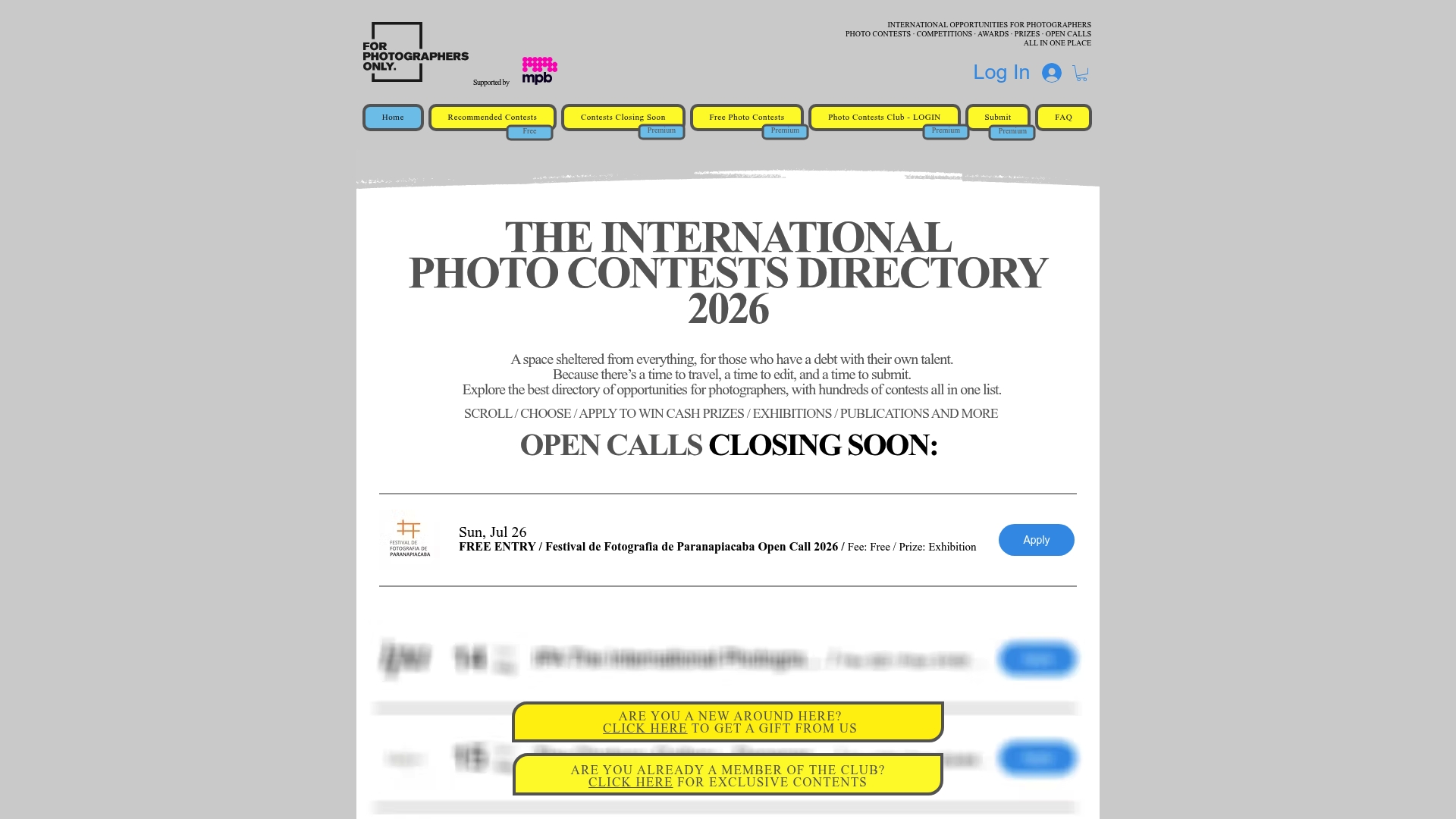
Browse the full PhotoContestsClub directory, or start with contests closing soon if you have work ready to submit. For a wider view of rights checks and editorial opportunities, see our guide to getting published through curated contests.
FAQ
Do I lose my copyright when I enter a photo contest?
Not unless the rules say you transfer it, and you should not agree to that. Copyright belongs to the photographer from the moment the image is fixed, according to the U.S. Copyright Office. A normal contest asks for a limited, non-exclusive license to display and promote entries.
Is it a red flag if a contest wants a license for all entries?
Not automatically. Many contests need to show entries online during judging. The question is scope: look for use limited to running and promoting the contest, a defined duration and a credit. Wording like “any purpose” and “in perpetuity” calls for a question to the organizer.
Do I need a model release for every contest?
Not always, but you should be ready. Some rules, such as the Smithsonian Magazine contest, call for releases for recognizable people, parental consent for minors and permission for copyrighted works shown in the image. Others ask only for releases on request. Keep signed releases on file from the shoot.
Can a legitimate contest ask me to pay after I win?
A legitimate organizer may ask you to cover taxes or fees tied to the prize, as the Smithsonian rules state. A demand for an upfront “processing fee” or for sensitive financial details to release a prize is a scam pattern the FTC warns about. Verify through the contest’s official website.
What should I do if I realize I misread the rules after entering?
Contact the organizer in writing as soon as possible, explain the issue and ask whether the entry can be corrected or withdrawn. Withdrawal costs are usually your own, so check fees and refund rules before you pay.
Sources
Recommended