Student Photography Competitions: Your 2026 Entry Guide

Which student photography competitions should you enter in 2026?
The strongest opportunities for emerging photographers combine credible judging, meaningful prizes, and genuine industry exposure. Here are the competitions worth your attention:
The Ultimate Student Photography Contest (School Photographers of America): Open to students across grade levels, this US-based contest champions serious picture taking and rewards participants with recognition among photography professionals nationwide.
International Photography Awards (IPA) / Sony World Photography Awards Student Competition: Open to photographers aged 18 to 30 enrolled in recognized institutions, requiring 5 to 10 images responding to a thematic brief. Shortlisted photographers receive digital imaging equipment and global exhibition exposure.
SOCAPA Student Contests: Designed for teen photographers, SOCAPA’s competitions encourage creative exploration and personal visual storytelling, making them an ideal entry point for high school students.
Congressional Art Competition: Sponsored by the U.S. House of Representatives, this annual competition is open to high school students and winners have their artwork displayed in the Capitol.
Scholastic Art & Writing Awards: One of the most respected youth recognition programs in the United States, open to students in grades 7 through 12, with gold and silver portfolio awards offering scholarship opportunities.
University Photographers Association of America (UPAA) Contests: Tailored for college-level photographers, UPAA competitions recognize excellence across documentary, sports, and portrait categories.
National Geographic Society Slingshot Challenge: Encourages students to use photography and storytelling to address real-world problems, with mentorship and publication opportunities through National Geographic’s education platform.
Journalism Education Association (JEA) Photography Contests: Structured for student journalists and photographers, JEA contests cover news, feature, and sports photography with awards recognizing editorial skill.
ILFORD Photo Student Competition (“Pretty Ugly” 2026/27): A distinctive film-based contest requiring physical print submissions on ILFORD black and white materials, rewarding students who work with traditional darkroom processes.
AOP Student Awards: Celebrating their 40th year in 2025, the AOP Student Awards are among the longest-running competitions for photography students at further education level or higher, with categories spanning People, Innovation, and beyond.
University of Chicago Study Abroad Photo Contest: Open to undergraduates studying abroad, this contest accepts a limited number of photos per experience and exhibits winners throughout the academic year.
Table of Contents
How to enter student photography competitions and who qualifies
Eligibility varies significantly across competitions, so reading the requirements before you invest time in preparing a submission is non-negotiable.
Most competitions define eligibility by age, enrollment status, or both. Youth photography contests like SOCAPA target high school students, while the Sony World Photography Awards Student Competition requires entrants to be 18 to 30 and currently enrolled in a recognized institution. For competitions organized by the World Photography Organisation, institutional registration is mandatory — students cannot submit independently, and their university must be officially listed with the organizers before any entry is accepted.
Typical steps to enter a student photography competition:
Confirm your eligibility by age range and current enrollment status.
Check whether your institution must register with the contest organizers before you can submit.
Gather required documents: student ID, proof of enrollment, or faculty endorsement letters.
Prepare your images according to the specified file format (usually JPEG), resolution, and naming convention (e.g., FirstNameLastNameTitle.jpg).
For film-based contests like ILFORD’s “Pretty Ugly,” print your images in a darkroom, package them in polythene wallets, and attach the required entry label to the back of each print.
Pay any applicable entry fee, or confirm free-entry eligibility. Many competitions offer reduced or waived fees for students.
Submit before the deadline — late entries are almost universally rejected without exception.
What judges look for in student photo contests
Understanding how your work will be evaluated is as important as the quality of the images themselves.

Most competitions organize entries into distinct categories. Common ones include portraiture, documentary, nature and wildlife, creative or experimental work, and in some cases moving image or short film. The AOP Student Awards specifically highlight categories like People and Innovation, signaling that conceptual ambition carries real weight alongside technical execution.
What judges consistently prioritize:
Serious picture taking: Judges seek evidence that the photographer engaged thoughtfully with their subject, not just pointed a camera at something visually appealing.
Unique personal perspective: Authentic viewpoints outperform technically polished but generic imagery. A compelling, unexpected angle on a familiar subject will draw more attention than a flawless but predictable composition.
Thematic interpretation: For competitions with a brief, judges assess how creatively and precisely the entrant responded to the prompt. Literal interpretations rarely win.
Originality and storytelling: A series or single image that communicates a clear narrative or emotional truth tends to resonate more than isolated technical showcases.
Avoiding clichés: Sunsets, symmetrical reflections, and heavily filtered street scenes are overrepresented in student submissions. Work that offers a fresh visual language stands apart.
Why entering photography competitions for students matters beyond the prize
The professional value of competing extends well past any trophy or cash award. Competitions connect emerging photographers with curators, commissioners, and established practitioners who shape the industry’s direction.
The Association of Photographers notes that student awards help bridge the educational and professional worlds, placing emerging talent directly in front of industry leaders. Programs like the AOP’s “Starting Out” initiative are built specifically to ease that transition. Being shortlisted alone adds credibility to a portfolio and signals to future clients or employers that your work has been evaluated by serious professionals.
Key benefits of entering student photography competitions:
Exhibition opportunities in galleries and international festivals that expand your public presence.
Publication in respected photography and arts magazines, building editorial visibility.
Mentorship connections with established photographers and industry figures.
Peer networking with other serious students from around the world, creating relationships that often outlast the competition itself.
Portfolio validation: a shortlist or award gives prospective clients and academic programs a concrete signal of your commitment and capability.
Pro Tip: After a competition closes, request feedback on your submission if the organizers offer it. Even a brief critique from a judge reveals more about your development than months of self-assessment. Pair that feedback with the networking opportunities competitions provide, and you accelerate your professional trajectory considerably. Understanding how to position that experience matters too — resources on commercial photography careers can help you translate competition recognition into real professional opportunities.
How to choose the right photography competition for your goals
Not every competition deserves your time and energy. Selecting strategically means entering contests where your work genuinely fits and where the recognition carries weight.
Match the category to your strengths. If your strongest work is documentary, enter competitions with a documentary or photojournalism category rather than forcing your images into a portraiture brief.
Assess the organizer’s reputation. Competitions backed by established institutions (National Geographic, the World Photography Organisation, the AOP) carry more industry credibility than unaffiliated contests with no verifiable judging panel.
Check the prize structure. Cash awards, equipment, exhibition slots, and publication features each serve different career goals. Prioritize accordingly.
Review the eligibility requirements before anything else. Discovering you are ineligible after preparing a full submission wastes time that could have gone toward a better-matched opportunity.
Use a curated directory. Forphotographersonly maintains a continuously updated photo contests directory, featuring over 320 active competitions, including more than 100 free-to-enter options, organized chronologically so you never miss a deadline.
Common mistakes to avoid in student photography competitions
Even strong photographers lose opportunities to avoidable errors. The most frequent ones are technical, not creative.

Submitting images in the wrong file format or at insufficient resolution is the fastest route to disqualification. Many competitions specify a minimum of 300 DPI for print categories and exact pixel dimensions for digital submissions. Ignoring the file-naming convention is equally costly — a file labeled “IMG_4892.jpg” instead of the required “FirstNameLastNameTitle.jpg” can be rejected before a judge ever sees it.
Entering the wrong category is a subtler mistake. Placing a documentary series in a creative/experimental category because the brief feels more flexible rarely works in your favor. Judges evaluate entries against the category’s specific criteria, and a mismatched submission signals a lack of attention to detail. Read every brief carefully, and when in doubt, contact the organizers directly.
Deadlines and important dates for competitions
Deadlines in student photography competitions are absolute. No competition of standing accepts late entries, and most close their submission portals at midnight on the stated date without warning.
Build a personal calendar that marks not just the final deadline but also any early-bird fee windows, institutional registration cutoffs (which often precede the student submission deadline by weeks), and announcement dates for shortlists and winners. The Sony World Photography Awards Student Competition, for example, requires university registration to be completed before individual students can submit — missing that institutional step means missing the competition entirely, regardless of when you prepared your images.
Check each competition’s official website directly for 2026 dates, as deadlines shift year to year. Forphotographersonly updates its directory weekly, making it a reliable source for current submission windows across international photography competitions.
What prizes and awards do student competitions offer?
Prize structures vary widely, and understanding what a competition actually awards helps you prioritize entries that serve your specific goals.
Cash prizes range from modest honoraria at local contests to substantial awards at internationally recognized competitions. The Sony World Photography Awards Student Competition offers digital imaging equipment alongside global exhibition opportunities. The Congressional Art Competition displays winning work in the U.S. Capitol for a full year, a form of public recognition that no cash equivalent can replicate. Scholastic Art & Writing Awards include scholarship opportunities, which carry direct financial value for students still in secondary school.
Beyond monetary rewards, many competitions offer publication in respected photography publications, inclusion in traveling exhibitions, and access to mentorship programs. The free-entry open calls listed on Forphotographersonly demonstrate that meaningful exposure does not always require an entry fee.
Submission categories across major student competitions
Most competitions organize entries into distinct categories to ensure fair comparison among similar work. Knowing which categories exist before you select your submission images is part of entering strategically.
Common categories across student photography competitions include: portraiture, documentary and photojournalism, nature and wildlife, architecture and urban environments, creative and experimental, still life, and in some competitions, moving image or short film. The AOP Student Awards specifically feature People and Innovation as named categories, reflecting the field’s growing interest in conceptual and socially engaged photography.
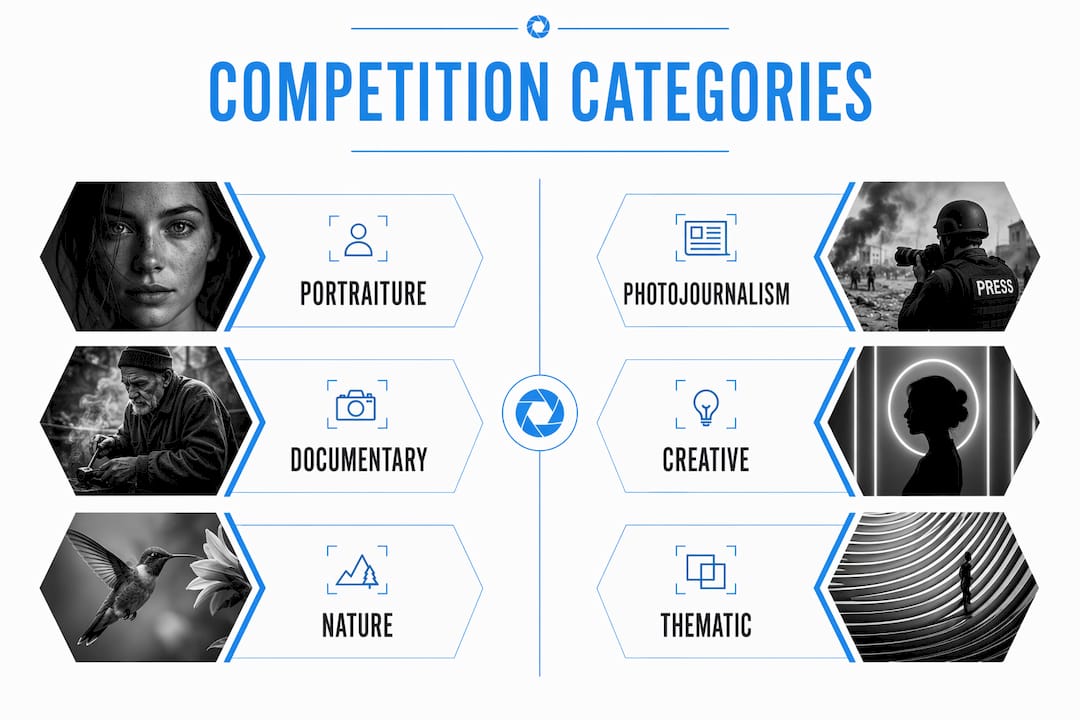
Some competitions, like the University of Chicago Study Abroad contest, are thematically unified rather than categorized, requiring all entries to respond to a single cultural or experiential brief. Others, like UPAA contests, are structured around professional practice areas such as sports, news, and feature photography. Matching your strongest existing work to the right category, rather than creating new work to fit a brief you are less comfortable with, consistently produces better results.
Key Takeaways
Student photography competitions offer emerging photographers a direct path from academic work to professional recognition, provided entries are prepared with care and submitted to the right contests.
Point | Details |
Institutional registration matters | Some competitions, including the Sony World Photography Awards, require your university to register before you can submit independently. |
Judges value perspective over perfection | Authentic, original viewpoints and strong thematic interpretation consistently outperform technically flawless but generic imagery. |
Deadlines are absolute | Build a calendar that includes institutional registration cutoffs, which often precede the student submission deadline by weeks. |
Prizes extend beyond cash | Exhibition slots, publication features, equipment awards, and mentorship programs often carry more long-term career value than monetary prizes. |
Use a curated directory | Forphotographersonly lists over 320 active competitions, including more than 100 free-to-enter options, updated weekly for current deadlines. |
Recommended